

Transcripts exist only for calls covered by AI transcription. Admins see every call in the company. Supervisors see calls from their own teams.
Open a transcript
1
Go to Reports
Go to Insights > Reports and pick the Outbound, Inbound, or Queue tab.
2
Find the call
Use the filters to narrow the list, then select Apply.
3
Open the transcript
In the RECORDING column, select the Open transcript icon next to the recording player. Calls without the icon have no transcript.

Read the conversation
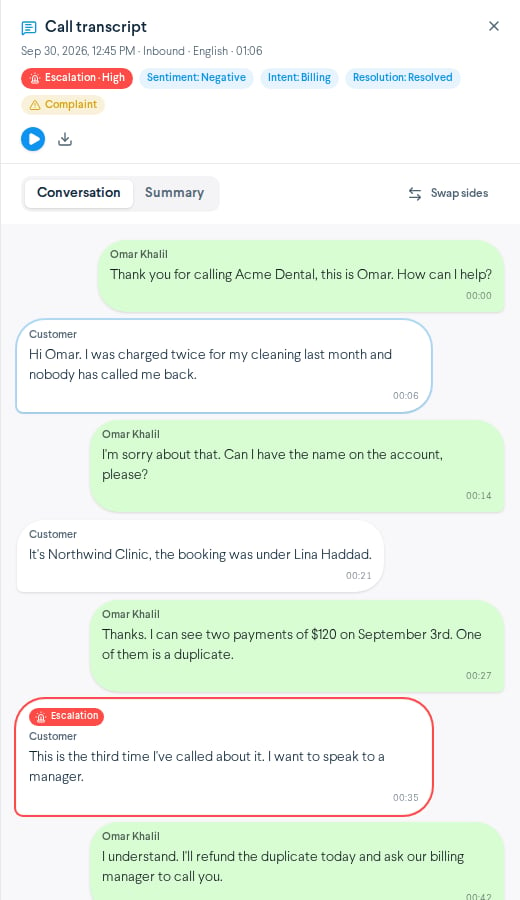
The Conversation tab shows the call as chat bubbles, one per turn. Each bubble shows who spoke, what they said, and when. Speaker labels work like this:- Select any bubble to play the recording from that point.
- Use the player at the top of the drawer to play or pause the recording.
Insight chips
Chips at the top of the drawer summarize the call:- Sentiment: the customer’s overall mood, from Very negative to Very positive.
- Intent: why the customer called, for example Support request, Billing, or Cancellation.
- Resolution: Resolved, Not resolved, or Unclear.
- Churn risk and Complaint appear when the call shows those signals.
- Uncertain appears when the result is not reliable enough to show.
Generate a summary
1
Open the Summary tab
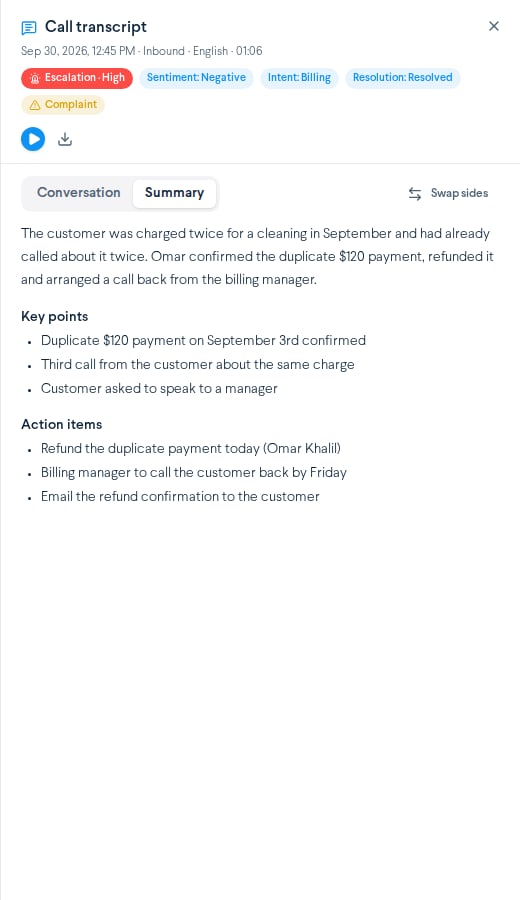
In the transcript drawer, select Summary.
2
Generate it
If the call has no summary yet, select Generate summary. It takes a few seconds.
3
Review it
Read the short summary, then the Key points and Action items.
Troubleshooting
There is no transcript icon on a call
There is no transcript icon on a call
The call was not transcribed. It may be shorter than the minimum call duration, of a call type you did not select, internal, or from before AI transcription was turned on. Transcription also takes a few minutes after the call ends.
"No speech was found in this call"
"No speech was found in this call"
The recording had no speech to transcribe, for example a silent or very short call.
"The summary could not be generated"
"The summary could not be generated"
A failed summary can’t be generated again from the drawer. Contact TalkChief support and include the call’s date, time, and phone number.
FAQ
Which languages are supported?
Which languages are supported?
Transcripts show each line in the language it was spoken. Calls that switch languages show more than one language in the drawer header.
Can agents see transcripts?
Can agents see transcripts?
No. Transcripts are available to admins and to supervisors for their own teams.
Can summaries be posted to CoWork?
Can summaries be posted to CoWork?
Escalated calls can be posted to CoWork channels with their summary. See Escalations.
Related
AI transcription setup
Turn on transcription and see pricing.
Call search
Find calls by what was said.
Escalations
Review calls that need a supervisor.
Reports and dashboards
Filter calls and play recordings.